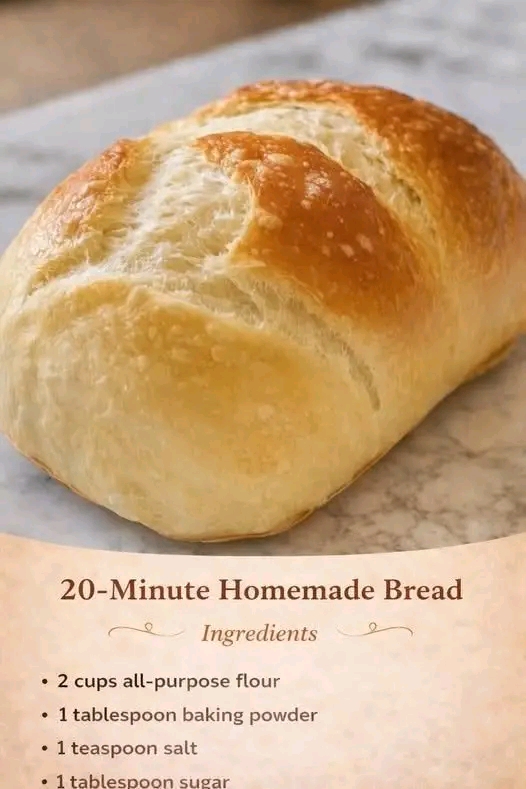
20-Minute Homemade Bread Quick, Easy, and Delicious
### 1\. Introduction
There is nothing quite like the comforting aroma of freshly made homemade bread. This 20-minute homemade bread recipe is perfect when you want warm, delicious bread without waiting hours for dough to rise. Made with simple pantry ingredients, it requires no yeast and no lengthy proofing.
With flour, baking powder, salt, a little sugar, warm water, and olive oil, you can prepare a quick bread that is soft inside and lightly golden outside. It is ideal for busy mornings, quick lunches, or serving alongside soups, salads, and hearty stews.
This recipe is especially convenient for beginner bakers who want to enjoy homemade bread without complicated techniques or special equipment.
### 2\. Origin
Quick breads have a long history in home cooking. Before commercial yeast became widely available, many cultures prepared simple flatbreads using flour, water, and salt, cooking them on hot stones, griddles, or in pans.
The introduction of chemical leavening agents such as baking powder made it possible to prepare breads quickly without yeast fermentation. This recipe follows that convenient tradition, combining everyday ingredients to create a simple bread suitable for modern kitchens.
Although it is not a traditional yeast loaf, it belongs to the broader family of quick breads and skillet breads that prioritize simplicity and speed.
### 3\. Cultural Significance
Bread is an important part of daily life in many cultures. It is shared at family meals, served with soups and stews, and often symbolizes hospitality and togetherness.
Quick homemade breads reflect the resourcefulness of home cooks who want to prepare something fresh with ingredients already in the cupboard. Whether served at breakfast or alongside dinner, this bread brings a homemade touch to even the simplest meal.
Its straightforward preparation also makes it a wonderful recipe to teach children and beginner cooks about basic baking.
### 4\. Ingredients Quantity
Preparation time: 5 minutes · Cooking time: 15 minutes · Total time: Approximately 20 minutes · Servings: 6
### Ingredients
* 3 cups (375 g) all-purpose flour
* 2 teaspoons baking powder
* 1 teaspoon salt
* 1 tablespoon sugar
* 1 cup (240 ml) warm water
* 2 tablespoons (30 ml) olive oil
Important: These ingredients make a quick, yeast-free bread. For the best results in 20 minutes, shape the dough into small flatbreads and cook them in a skillet. A thick, conventional oven-baked loaf generally needs more time to cook through.
### 5\. Optional Additions
Customize your bread with these simple ingredients:
* Garlic: Add 1–2 minced garlic cloves for a savory flavor.
* Fresh herbs: Mix in chopped parsley, rosemary, or oregano.
* Seeds: Add sesame, sunflower, or flaxseeds for extra texture.
* Black pepper: Include a pinch for a gentle, savory kick.
* Whole-wheat flour: Replace up to half the all-purpose flour for more fiber; add a little extra water if necessary.
* Dairy-free flavor: Brush the cooked bread with olive oil mixed with garlic and herbs.
* Cheese: Add a small amount of grated Parmesan or another favorite cheese.
* Spices: Try cumin, paprika, or za’atar for a Mediterranean or Middle Eastern-inspired variation.
### 6\. Tips for Success
* Measure the flour carefully. Too much flour can make the bread dry and dense.
* Use warm, not hot, water. Lukewarm water helps the ingredients combine easily.
* Do not overmix. Knead only until the dough becomes smooth and cohesive.
* Adjust the consistency. Add water a teaspoon at a time if the dough is dry, or a light dusting of flour if it is too sticky.
* Roll evenly. Flatbreads of similar thickness cook at approximately the same rate.
* Preheat the skillet. A hot pan helps develop golden-brown spots.
* Avoid excessive heat. Medium heat allows the centers to cook before the outsides burn.
* Keep the bread covered. Wrap cooked flatbreads in a clean kitchen towel to retain their softness.
### 7\. Instructions
### Step 1: Combine the dry ingredients
In a large mixing bowl, combine the flour, baking powder, salt, and sugar. Stir thoroughly to distribute the baking powder evenly.
### Step 2: Add the wet ingredients
Pour in the warm water and olive oil. Mix with a wooden spoon until a rough dough forms.
### Step 3: Knead the dough
Transfer the dough to a lightly floured surface. Knead gently for approximately 2–3 minutes, until it becomes smooth and manageable.
### Step 4: Divide and shape
Divide the dough into 6 equal portions. Roll each portion into a ball, then flatten it with a rolling pin into a circle approximately 3–5 mm thick.
### Step 5: Heat the skillet
Place a heavy skillet over medium heat. Allow it to heat thoroughly before cooking the first piece. A dry skillet works well, although you can lightly brush it with olive oil if needed.
### Step 6: Cook the bread
Place one flatbread in the skillet. Cook for approximately 2–3 minutes, until bubbles appear and the underside develops golden-brown spots. Flip and cook for another 2–3 minutes, adjusting the heat as needed.
Repeat with the remaining portions. Depending on the pan and thickness, the bread may need a little extra cooking time.
### Step 7: Keep warm and serve
Transfer the cooked bread to a plate and cover it with a clean towel. Serve warm with your favorite dishes, dips, or spreads.
### 8\. Description
This 20-minute homemade bread is simple, versatile, and satisfying. The baking powder provides a little lift without the need for yeast, while olive oil helps keep the dough tender.
The finished flatbreads are lightly golden on the outside and soft enough to fold, tear, or use to scoop up sauces. Their mild flavor makes them suitable for both savory and lightly sweet toppings.
Best of all, the recipe uses inexpensive ingredients and requires no special baking equipment.
### 9\. Nutritional Information
Estimated nutritional values per flatbread, assuming six equal portions:
* Calories: 290–320 kcal
* Protein: 6–8 g
* Carbohydrates: 48–54 g
* Fat: 6–8 g
* Fiber: 1–2 g
* Sugar: 2–3 g
* Sodium: 550–700 mg
Values are approximate and depend on the flour brand, exact portion sizes, and amount of salt used. The sodium content can be reduced by using less salt.
### 10\. Conclusion
This 20-minute homemade bread is a practical solution when you want fresh bread without yeast or a long rising time. With just six basic ingredients, you can make a batch of warm skillet flatbreads that complement a wide variety of meals.
Whether you are preparing a quick breakfast, serving a family dinner, or looking for an easy accompaniment to soup, this recipe offers a straightforward way to bring homemade goodness to your table.
### 11\. Recommendation
Serve these flatbreads with vegetable soup, lentil stew, grilled chicken, roasted vegetables, hummus, or a fresh tomato salad. They are also delicious brushed with garlic-infused olive oil and sprinkled with fresh parsley.
For breakfast, try them with eggs or avocado. For a quick lunch, use them as wraps filled with vegetables, beans, or your preferred protein.
Store cooled flatbreads in an airtight container in the refrigerator for up to 3 days. Reheat them in a dry skillet for about 30–60 seconds per side to restore their softness. They can also be frozen, separated with baking paper, for up to 2 months.
### 12\. Embracing Healthful Indulgence
Homemade bread can be enjoyed as part of a balanced diet. Making it yourself allows you to control the ingredients, adjust the salt, and experiment with different types of flour.
For a more fiber-rich variation, replace some of the all-purpose flour with whole-wheat flour or add ground flaxseed. Pairing the bread with vegetables and protein-rich foods, such as eggs, beans, lentils, or grilled chicken, can make a meal more satisfying.
If you prefer to avoid added sugar, you can omit the tablespoon of sugar; the bread should still work, although its flavor and browning may change slightly. If you avoid white flour, try a whole-wheat version, adding water gradually because whole-wheat flour absorbs more liquid and produces a denser texture.
Remember that bread does not need to be eliminated to eat healthfully. Enjoying a suitable portion alongside nourishing foods can be a simple and sustainable way to balance comfort, flavor, and nutrition.
Love easy homemade recipes? Save this recipe, share it with your friends, and leave a comment telling us whether you prefer your bread plain, with garlic, or packed with herbs. Your support helps keep more simple homemade recipes coming!