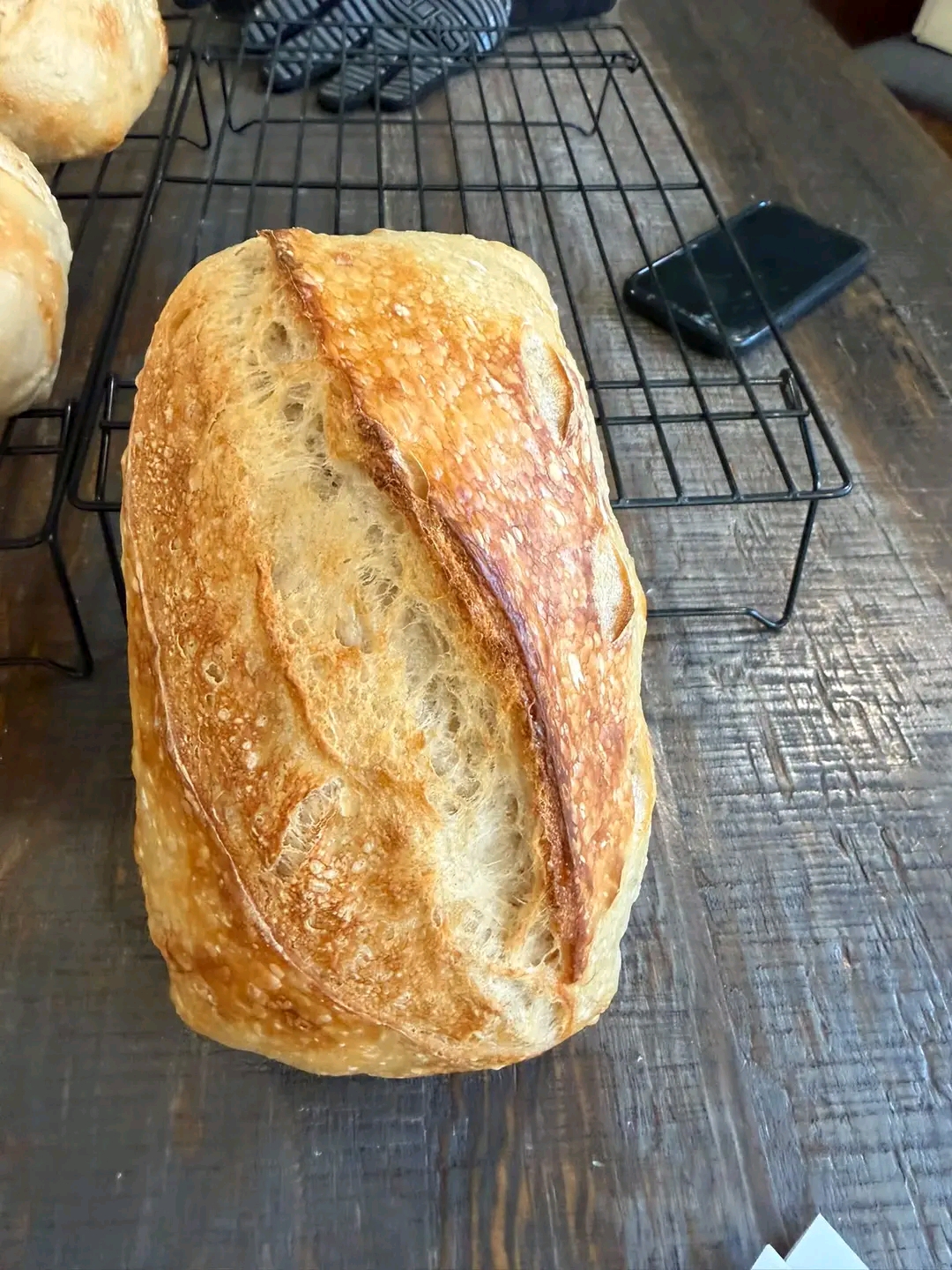
### Homemade Artisan Sourdough Loaf Bread – Simple, Crusty, and Full of Flavor
### Introduction
There is something truly special about homemade artisan bread made with just four simple ingredients: sourdough starter, water, flour, and salt. This rustic loaf has a beautifully crisp crust, a chewy interior, and the distinctive tangy flavor that makes naturally fermented bread so delicious.
If you already love making artisan sourdough, turning your favorite dough recipe into a traditional loaf is a wonderful way to enjoy homemade bread every day. Whether served toasted at breakfast, alongside a warm bowl of soup, or topped with your favorite ingredients, this bread celebrates the beauty of simple baking.
### Origin
Artisan bread has a long history that stretches back thousands of years, when people began combining flour and water to create simple doughs. Natural fermentation developed as wild yeasts and beneficial bacteria in the environment helped dough rise and develop flavor.
Sourdough baking became an important traditional method in many cultures, especially before commercial baker’s yeast became widely available. Today, artisan sourdough remains popular because of its distinctive flavor, rustic appearance, chewy texture, and traditional preparation methods.
### Cultural Significance
Homemade sourdough bread represents patience, craftsmanship, and the satisfaction of creating something from scratch. Across generations, families have maintained sourdough starters, shared baking techniques, and developed their own signature loaves.
The modern artisan bread movement celebrates these traditions by focusing on quality ingredients, long fermentation, and hands-on techniques. Making a loaf with only starter, water, flour, and salt is a wonderful reminder that excellent bread does not require a long ingredient list.
### Ingredients Quantity
Preparation time: 25 minutes Bulk fermentation: 4–6 hours, depending on temperature and starter activity Cold fermentation: 8–16 hours, optional Baking time: 40–50 minutes Servings: 1 large loaf, approximately 10–12 slices
### Ingredients
* 100 g active sourdough starter
* 350 g water, preferably at room temperature
* 500 g bread flour or strong all-purpose flour
* 10 g salt
These quantities create a dough with approximately 75% hydration, assuming a 100%-hydration starter. The dough may feel soft and slightly sticky, so handle it gently.
### Optional Additions
The beauty of this recipe is that nothing extra is necessary. However, if you enjoy experimenting, you could try:
* Whole-wheat flour: Replace 50–100 g of the bread flour for a nuttier flavor.
* Rye flour: Replace 25–50 g of the flour for a deeper, earthier taste.
* Seeds: Add sunflower, sesame, or pumpkin seeds for extra crunch.
* Fresh herbs: Incorporate rosemary or thyme for a fragrant loaf.
* Roasted garlic: Add roasted garlic for a savory variation.
For a traditional four-ingredient loaf, simply stick with the starter, water, flour, and salt.
### Tips for Success
* Use an active starter. Your starter should be bubbly, smell pleasantly tangy, and rise predictably after feeding.
* Measure by weight. A digital kitchen scale helps maintain consistent hydration and dough structure.
* Allow fermentation to guide you. Temperature, flour, and starter strength affect how quickly dough rises.
* Develop the gluten. Use stretch-and-fold or coil-fold techniques during the first part of bulk fermentation.
* Watch the dough, not just the clock. Look for a noticeable increase in volume, bubbles along the sides, and a lighter, airier feel.
* Shape with gentle tension. A well-shaped loaf holds its form and rises more effectively in the oven.
* Use a loaf pan if desired. If you want a traditional sandwich-style loaf, shape the dough to fit a lightly greased loaf pan.
* Bake thoroughly. A deep golden crust and an internal temperature around 205–210°F (96–99°C) are useful indicators.
* Cool completely. Let the bread cool for at least 2 hours before slicing to prevent a gummy interior.
### Instructions
### Step 1: Mix the ingredients
In a large bowl, combine the sourdough starter and water. Add the flour and mix until no dry flour remains. Cover and let the dough rest for 30 minutes.
### Step 2: Add the salt
Sprinkle the salt over the dough. Work it in with damp hands, pinching and folding the dough until the salt is evenly distributed.
### Step 3: Begin bulk fermentation
Cover the bowl and let the dough ferment at room temperature. During the first 2 hours, perform 3–4 sets of stretch-and-folds about 30 minutes apart.
To stretch and fold, lift one side of the dough, stretch it gently upward, and fold it over the center. Rotate the bowl and repeat on the remaining sides.
### Step 4: Let the dough rise
Continue bulk fermentation until the dough has risen noticeably, feels aerated, and shows bubbles. Depending on room temperature and starter strength, this may take another 2–4 hours or longer.
Avoid relying on a fixed percentage increase for every dough; the right endpoint depends on your flour, temperature, and fermentation conditions.
### Step 5: Shape the loaf
Turn the dough onto a lightly floured surface. Gently shape it into a round or oval loaf, creating enough surface tension to help it hold its form.
For a sandwich loaf, gently shape it into a log and place it seam-side down in a greased loaf pan.
### Step 6: Proof the dough
Place the shaped dough in a floured proofing basket or loaf pan. Cover and allow it to proof until slightly puffy.
You can bake it the same day or refrigerate it for 8–16 hours to develop additional flavor and make scoring easier.
### Step 7: Preheat the oven
For a free-standing artisan loaf, preheat the oven to 475°F (245°C) with a Dutch oven inside.
For a loaf-pan version, preheat the oven to 425°F (220°C).
### Step 8: Score and bake
For a Dutch oven loaf, carefully transfer the dough onto parchment paper, score the surface with a sharp blade, and place it into the hot Dutch oven.
Bake covered for 20 minutes, then uncover and bake for another 20–25 minutes, until the crust is deeply golden.
For a loaf-pan version, score the top if desired and bake for approximately 35–45 minutes, adjusting as necessary for your oven and pan.
### Step 9: Cool and slice
Remove the bread from the oven and transfer it to a wire rack. Let it cool completely before slicing.
Enjoy your homemade artisan loaf with its crisp crust, chewy crumb, and naturally fermented flavor.
### Description
This artisan sourdough loaf has a rustic, golden crust and a tender, chewy interior. Natural fermentation creates complex flavors, while the simple combination of flour, water, starter, and salt allows the quality of the dough to shine.
The loaf is delicious fresh, toasted, or served alongside soups and stews. It also makes an excellent base for sandwiches or a simple slice topped with olive oil, tomatoes, and herbs.
### Nutritional Information
Estimated nutrition per slice, assuming one loaf produces 12 slices:
* Calories: 150–170
* Protein: 5–6 g
* Carbohydrates: 30–34 g
* Fat: 0.5–1.5 g
* Fiber: 1–2 g
* Sugar: Less than 1 g
* Sodium: 250–350 mg
Values depend on the flour used, the starter’s composition, loaf size, and slice thickness.
### Conclusion
Homemade artisan sourdough bread proves that a handful of ingredients can produce something extraordinary. With a lively starter, proper fermentation, gentle shaping, and careful baking, you can create a flavorful loaf that is perfect for everyday meals.
Whether you prefer a rustic round loaf or a neat sandwich-style loaf, your existing artisan dough recipe can often be adapted to suit your preferred shape. The key is to adjust the proofing and baking method to match the loaf you want.
### Recommendation
If you love the flavor and texture of your current artisan dough, try baking a portion of it in a loaf pan. This is especially useful if you want more uniform slices for toast and sandwiches.
Start with your usual recipe and keep the ingredients unchanged. Shape the dough into a log after bulk fermentation, place it in a greased loaf pan, proof until puffy, and bake at approximately 400–425°F (205–220°C). Watch the crust and check that the center is fully baked.
Store the cooled loaf in a bread bag or bread box for a few days, or slice and freeze it for convenient toast whenever you want.
### Embracing Healthful Indulgence
Traditional sourdough bread offers a simple ingredient list and can fit comfortably into a balanced diet. It provides carbohydrates for energy and some protein and minerals from the flour. Fermentation may also alter the availability of certain nutrients and reduce some fermentable carbohydrates, although the effects vary by recipe and fermentation conditions.
For a more fiber-rich loaf, try replacing a small portion of the white flour with whole-wheat or rye flour. This will change the dough’s water absorption and may require a little more water.
If you prefer to keep your bread free of added sugar, oil, dairy, and commercial yeast, this four-ingredient recipe already meets those preferences. Remember that sourdough made with ordinary wheat flour still contains gluten.
The real beauty of this bread is its simplicity: a healthy, active starter, flour, water, salt, and time come together to create a loaf full of homemade character.