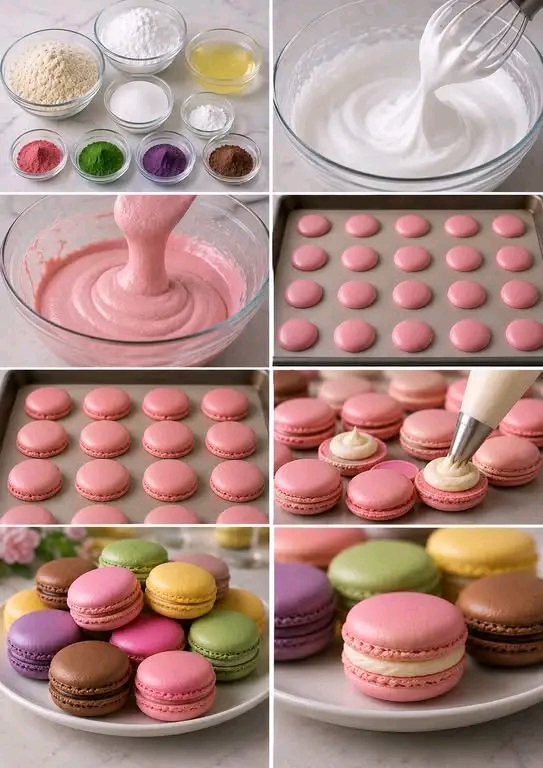
French Macarons
Introduction
French macarons are delicate, elegant sandwich cookies with smooth, lightly crisp shells and a soft, chewy center. Made primarily with almond flour and whipped egg whites, they can be filled with buttercream, ganache, fruit curd, or other creamy fillings. Although they look simple, successful macarons depend on careful mixing, accurate measurements, and proper baking.
Prep Time: 30 minutes
Resting Time: 30–60 minutes
Bake Time: 12–15 minutes per tray
Total Time: About 1½–2 hours
Yield: Approximately 24–30 filled macarons
Origin
The modern French macaron is strongly associated with French pastry-making, although almond-based meringue cookies have older European roots. Over time, French pastry chefs developed the familiar version consisting of two almond-meringue shells joined by a flavorful filling. Today, macarons are one of France’s most recognizable pastries.
Cultural Significance
Macarons have become symbols of French elegance and refined pâtisserie. They are commonly found in pastry shops, cafés, celebrations, weddings, afternoon tea settings, and gift boxes. Their colorful appearance and wide variety of flavors have helped make them popular around the world.
Ingredients Quantity
Macaron Shells
1 cup almond flour
1¾ cups powdered sugar
3 large egg whites, preferably room temperature
¼ cup granulated sugar
¼ teaspoon cream of tartar
Food coloring, as desired
Filling
A simple vanilla buttercream works beautifully:
½ cup unsalted butter, softened
1½ cups powdered sugar
1 teaspoon vanilla extract
1–2 tablespoons heavy cream or milk
Pinch of salt
Optional Additions
1 teaspoon vanilla bean paste
Lemon or orange zest
Unsweetened cocoa powder for chocolate shells
Freeze-dried raspberry powder
Pistachio flavoring
Chocolate ganache instead of buttercream
Raspberry or strawberry jam
Lemon curd
Caramel buttercream
Different food colors to match the flavor
Tips for Success
Measure by weight when possible. Macarons are particularly sensitive to ingredient ratios.
Use almond flour that is finely ground and sift it with the powdered sugar.
Make sure your mixing bowl and beaters are completely clean and free from grease.
Room-temperature egg whites generally whip more easily.
Beat the meringue until it forms firm, glossy peaks, but avoid taking it so far that it becomes dry.
The macaron batter should flow slowly from the spatula and settle back into itself rather than remaining in a stiff mound.
Tap the baking sheet gently after piping to release large air bubbles.
Let the piped shells rest until the surface feels dry before baking.
Avoid opening the oven repeatedly during baking.
Let the shells cool completely before filling.
For the best texture, refrigerate filled macarons overnight and bring them toward room temperature before serving.
Instructions
1. Prepare the dry ingredients: Sift the almond flour and powdered sugar together into a bowl. Discard or re-sift any large pieces.
2. Whip the egg whites: Place the egg whites and cream of tartar in a clean mixing bowl. Beat until foamy.
3. Gradually add the granulated sugar while continuing to whip. Beat until the meringue is glossy and holds firm peaks.
4. Add food coloring if desired and mix gently until evenly distributed.
5. Make the macaronage: Fold the sifted almond-flour mixture into the meringue in several additions. Continue folding until the batter becomes smooth and flows slowly from the spatula.
6. Transfer the batter to a piping bag fitted with a round tip.
7. Pipe small, evenly sized rounds onto a parchment-lined baking sheet.
8. Tap the tray gently against the counter several times to release air bubbles. Pop any visible bubbles with a toothpick.
9. Let the shells rest for approximately 30–60 minutes, or until the tops are dry to the touch.
10. Preheat the oven to approximately 300°F (150°C). Bake for about 12–15 minutes, adjusting the time for your oven and shell size.
11. Allow the shells to cool completely on the baking sheet before removing them.
12. Prepare the filling: Beat the softened butter until creamy. Gradually add powdered sugar, then vanilla, salt, and enough cream or milk to create a smooth, pipeable consistency.
13. Pipe a small amount of filling onto one macaron shell and gently sandwich it with another.
14. Refrigerate the filled macarons for several hours, preferably overnight, before serving.
Description
These French macarons have a delicate, smooth exterior with a slightly crisp bite that gives way to a soft, chewy almond center. The creamy filling adds richness and allows you to create endless flavor combinations. Their colorful appearance makes them especially beautiful for parties and special occasions.
Nutritional Information
Approximate per filled macaron; values vary considerably depending on the filling and size:
Calories: 90–120
Protein: 2 g
Carbohydrates: 13–17 g
Fat: 4–6 g
Fiber: 0.5–1 g
Sugar: 11–14 g
Sodium: 20–50 mg
Conclusion
French macarons are a rewarding baking project that combines simple ingredients with precise technique. Once you master the meringue and macaronage stages, you can experiment with countless colors and fillings to create your own signature macarons.
Recommendation
For the best results, make the macarons a day before serving. The filling has time to soften the centers slightly, creating the characteristic tender texture. Pair flavors thoughtfully—for example, pistachio with raspberry, vanilla with salted caramel, or chocolate with espresso.
Embracing Healthful Indulgence
Macarons are definitely a treat, but their small size makes them naturally suited to enjoying one or two thoughtfully rather than a large portion. Almond flour contributes some protein, healthy fats, and vitamin E, while the traditional recipe is still relatively high in powdered sugar. For a lighter variation, consider a less-sweet filling or use a naturally flavored fruit filling while keeping the delicate macaron shells as the centerpiece.