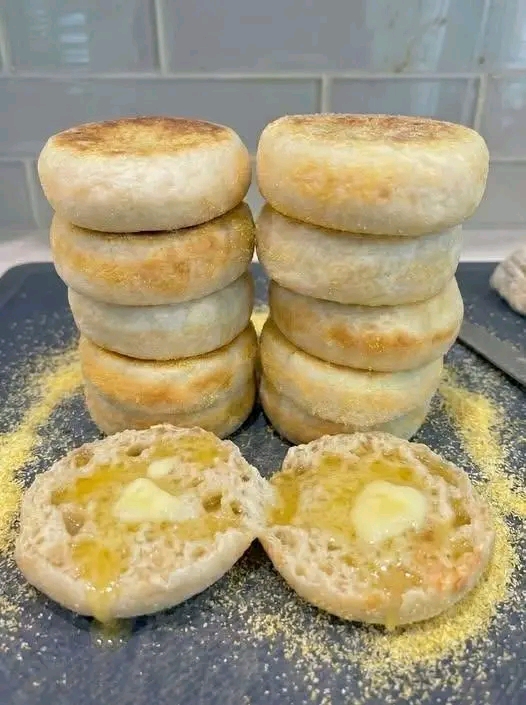
#Homemade English Muffins Soft, Fluffy, Golden and Better Than Store-Bought!
### 1\. Introduction
Once you make homemade English muffins, you may never want to buy them from the grocery store again! These delicious little breads are soft, tender, slightly chewy, and filled with those wonderful little nooks and crannies that catch melted butter, jam, and honey.
Making English muffins from scratch may seem intimidating at first, but the process is surprisingly simple. The dough comes together with basic ingredients, and instead of baking them in the oven, these muffins are traditionally cooked on a skillet or griddle.
Even if your first attempt isn’t perfectly round or uniform, the flavor and texture will make you fall in love with homemade English muffins. They are especially delicious when split open with a fork and toasted until golden.
### 2\. Origin
English muffins have an interesting history dating back to nineteenth-century England.
They became particularly popular during the Victorian era, when small yeast-leavened breads were commonly prepared and sold by bakers and street vendors.
English muffins eventually became popular in North America, where they developed into a breakfast staple. Unlike traditional American muffins, which are sweet quick breads, English muffins are yeast-raised breads cooked on a griddle.
Today, they are enjoyed worldwide for breakfast sandwiches, toasted snacks, and delicious brunch dishes.
### 3\. Cultural Significance
English muffins have become an important part of breakfast traditions in both Britain and North America.
They are especially popular served toasted with butter, jam, honey, or marmalade. In the United States, they are also widely used for breakfast sandwiches with eggs, cheese, and sausage.
For home bakers, making English muffins from scratch is a rewarding experience. The irregular shapes, golden surfaces, and beautiful interior texture give homemade muffins a special charm.
And just like homemade sourdough bread, once you discover how delicious freshly prepared English muffins can be, store-bought versions may never taste quite the same!
### 4\. Ingredients Quantity
Makes 12 English muffins
Preparation Time: 25 minutes Rising Time: 1½–2 hours Cooking Time: 20–25 minutes Total Time: Approximately 2 hours 50 minutes
* 3½ cups (440 g) bread flour
* 1 cup (240 ml) warm milk
* 2 tablespoons (25 g) granulated sugar
* 2¼ teaspoons (7 g) active dry yeast
* 1 teaspoon salt
* 2 tablespoons (28 g) softened butter
* 1 large egg
* ¼ cup cornmeal or semolina for dusting
### 5\. Optional Additions
You can customize your English muffins with several delicious additions:
* 1 teaspoon cinnamon for a lightly spiced flavor.
* ½ teaspoon vanilla extract for a subtle sweetness.
* 2 tablespoons honey instead of some of the sugar.
* ¼ cup raisins for naturally sweet bites.
* ½ cup shredded cheddar cheese for savory muffins.
* 1 tablespoon dried herbs for a delicious sandwich-style muffin.
* Whole-wheat flour replacing up to 25% of the bread flour for additional fiber.
### 6\. Tips for Success
Use warm, not hot, milk: The milk should feel comfortably warm, around 105–110°F (40–43°C). Excessive heat can damage the yeast.
Knead until smooth: Proper gluten development helps create the soft, chewy interior.
Don’t add too much flour: The dough should be soft and slightly tacky. Adding excessive flour can produce dense muffins.
Allow enough rising time: Let the dough rise until approximately doubled in size.
Roll evenly: Aim for approximately ½-inch thickness so the muffins cook evenly.
Use a gentle heat: English muffins need time to cook through without burning their outsides.
Don’t expect perfect shapes: Homemade English muffins often have slightly irregular edges. Their flavor matters much more than appearance!
Split with a fork: Instead of cutting with a knife, use a fork to separate the muffins. This helps preserve their characteristic nooks and crannies.
### 7\. Instructions
1\. Activate the yeast: In a small bowl, combine the warm milk, sugar, and active dry yeast. Let stand for 5–10 minutes until foamy.
2\. Combine the ingredients: In a large mixing bowl, combine the bread flour and salt. Add the yeast mixture, softened butter, and egg.
3\. Make the dough: Mix until a rough dough forms.
4\. Knead: Knead by hand for approximately 8–10 minutes or in a stand mixer for 5–7 minutes until smooth and elastic.
5\. First rise: Place the dough in a lightly greased bowl, cover, and let rise in a warm place for approximately 1–1½ hours, or until doubled in size.
6\. Prepare the dough: Transfer the dough to a lightly floured surface and gently roll it to approximately ½-inch thickness.
7\. Cut the muffins: Use a 3-inch round cutter to cut out individual muffins. Gather and reroll the scraps gently.
8\. Prepare for the second rise: Sprinkle a baking sheet with cornmeal or semolina. Arrange the muffins on top, leaving space between them. Sprinkle a little more cornmeal over the tops.
9\. Second rise: Cover loosely and allow the muffins to rise for approximately 30–45 minutes until puffy.
10\. Heat the skillet: Preheat a heavy skillet or griddle over low to medium-low heat.
11\. Cook the muffins: Place the muffins in the dry skillet and cook for approximately 7–10 minutes on each side. Adjust the heat as necessary to prevent excessive browning.
12\. Check doneness: The muffins should be golden brown and cooked through. If necessary, finish them in a 350°F (175°C) oven for approximately 5–8 minutes.
13\. Cool: Transfer to a wire rack and allow them to cool before splitting.
14\. Serve: Split with a fork, toast until golden, and enjoy with butter, jam, honey, or your favorite breakfast fillings.
### 8\. Description
These homemade English muffins are beautifully golden on the outside, soft and chewy inside, and filled with the signature nooks and crannies that make them so special.
Their slightly crisp exterior contrasts wonderfully with the tender interior, making every bite delicious.
When toasted, the little holes catch melted butter and create an irresistible breakfast experience.
They may not all look perfectly identical, especially on your first attempt, but their homemade flavor makes every muffin worth the effort!
### 9\. Nutritional Information
Estimated per muffin, assuming 12 muffins without toppings.
| Nutrient | Amount |
| ————- | ——– |
| Calories | 190 kcal |
| Protein | 6 g |
| Carbohydrates | 34 g |
| Fat | 4 g |
| Saturated Fat | 2 g |
| Fiber | 1.5 g |
| Sugar | 3 g |
| Sodium | 200 mg |
Actual values depend on the ingredients and muffin size.
### 10\. Conclusion
Homemade English muffins are one of those recipes that make you wonder why you ever purchased them from the store.
They are delicious, versatile, and surprisingly satisfying to prepare. From mixing the dough to watching the muffins turn golden in the skillet, every step brings you closer to a wonderful homemade breakfast.
Your first batch doesn’t need to look perfect. With every attempt, you’ll improve your shaping, thickness, and cooking technique.
And once you taste them warm and freshly toasted, you may understand why homemade English muffins are so addictive!
### 11\. Recommendation
Enjoy your English muffins in different ways throughout the week:
* Toasted with butter and homemade strawberry jam.
* Topped with scrambled eggs and avocado.
* Used for breakfast sandwiches with eggs and bacon.
* Spread with almond butter and banana slices.
* Served with cream cheese and fresh berries.
* Used as the base for homemade mini pizzas.
For convenient breakfasts, allow the muffins to cool completely, slice them with a fork, and freeze them in an airtight freezer bag. You can toast them directly from frozen.
### 12\. Embracing Healthful Indulgence
Homemade English muffins offer the advantage of controlling your ingredients and avoiding unnecessary preservatives and additives often found in packaged breads.
You can experiment with whole-wheat flour, reduce the added sugar slightly, or incorporate seeds such as flaxseed and chia for additional fiber.
For a dairy-free variation, use an unsweetened plant-based milk and replace the butter with olive oil or a suitable dairy-free alternative.
Pair your toasted muffins with eggs, avocado, nut butter, or fresh fruit for a more balanced breakfast.
Homemade baking is about enjoying delicious food while choosing ingredients that work for your lifestyle.
Final Thought: Your first homemade English muffins might not be perfectly shaped, but when they come out golden, warm, and full of delicious little air pockets, you’ll realize that homemade really is worth it. And just like your sourdough baking adventures, practice will only make them better!